
Wichita City Directory Holdings
Wichita city directory holdings do not form one unbroken run. The Midwest Historical and Genealogical Society index lists specific early years, while Internet Archive provides image scans for three Polk volumes. Wichita Public Library holds later city and telephone directories, but its public page does not enumerate every year. Check the exact volume before citing an entry.
| Directory collection | Years or run | Repository | Access path |
|---|---|---|---|
| MHGS Wichita directory index | 1877, 1878, 1881, 1883, 1885, 1886-1892, 1894, 1902, 1904-05 | MHGS | Online index; verify each linked scan |
| Polk scanned directories | 1878, 1883, 1885 | Internet Archive, Allen County Public Library contribution | Free page images, OCR, and metadata |
| 1900 business directory | 1900 | MHGS publication list | Separate business volume, not a full household roll |
| City and telephone directories | Years not fully listed online | Wichita Public Library Local History collection | Burns Pavilion research room and staff research |
| Ward and address context | 1926 ward map | MHGS online resources | Map support for street and precinct clues |
The index does not prove that every linked file still opens, and it does not establish the last printed Wichita volume. Several links were stale during research. A missing year is a gap in the located collection, not proof that a resident left town.
Early Wichita Directory Years
The first Wichita directory year located in the local index is 1877. Polk published the digitized 1878, 1883, and 1885 volumes. Their title pages and image scans provide better evidence than OCR alone, which can split names, confuse initials, and misread house numbers.
A short timeline keeps the known runs separate from broader local history:
| 1877 | Earliest Wichita run listed by MHGS. |
|---|---|
| 1878 | Polk directory and immigrant guide, digitized online. |
| 1881-1894 | Selected years and a near-annual 1886-1892 run appear in the MHGS index. |
| 1900 | MHGS lists a business-directory publication, which needs its own label. |
| 1902-1905 | Later early runs listed locally, including a two-year 1904-05 volume. |
Wichita incorporated in 1870, and Kansas archives preserve city and township records from the same early era. That context helps explain why a person can appear in an official docket or assessment source before appearing in a directory run.
Open Wichita City Directories Online
Three early Wichita city directories have stable Internet Archive records: 1878, 1883, and 1885. Search OCR to find likely pages, then inspect the page image. Copy the original spelling, punctuation, abbreviation, and page number before normalizing a name or address.
The Wichita Public Library Digital Archives reports 70 collections and added Family Histories in January 2026. It includes photographs and local documents, though rights and date ranges vary by collection. It complements the directories rather than replacing the physical shelf.
Read a Wichita Directory Entry
Begin in the address or street section when the location is known. Record the printed householder or occupant, then find that name in the alphabetical section. A Wichita directory entry may combine several facts in a very short line, and the volume's own abbreviation key controls their meaning.
| Name | Surname, given name, initials, and sometimes a spouse or household relationship. |
|---|---|
| Occupation | Work or role as the publisher recorded it, sometimes with an institution or business. |
| Address | House number and abbreviated street string; preserve it before modernizing. |
| Owner or renter mark | A symbol or notation in editions that distinguish tenure. |
| Widow notation | A relationship clue, not proof of a date of death. |
| Page and section | The citation needed to return to the original image. |
- Criss-cross directory
- A directory arranged by address, letting a reader move from house number to printed occupant.
- Householder index
- An address-oriented list centered on the person identified with a household.
- Abbreviation key
- The volume's guide to shortened street types, occupations, relationships, and residence marks.
A business, boarding-house, or rooming-house entry is evidence of a directory relationship, not proof that every named person lived there full time. Photograph or save the key and title page with the entry.
Wichita Directory Research Rooms
The Wichita Public Library Local History collection at the Burns Historical Research Pavilion includes city directories, telephone books, maps, atlases, Sanborn maps, newspapers, and more than 25,000 genealogy volumes. It has two microfilm scanners with free save or email and 25-cent prints. Mail research costs $5 per half-hour, with a one-hour maximum.
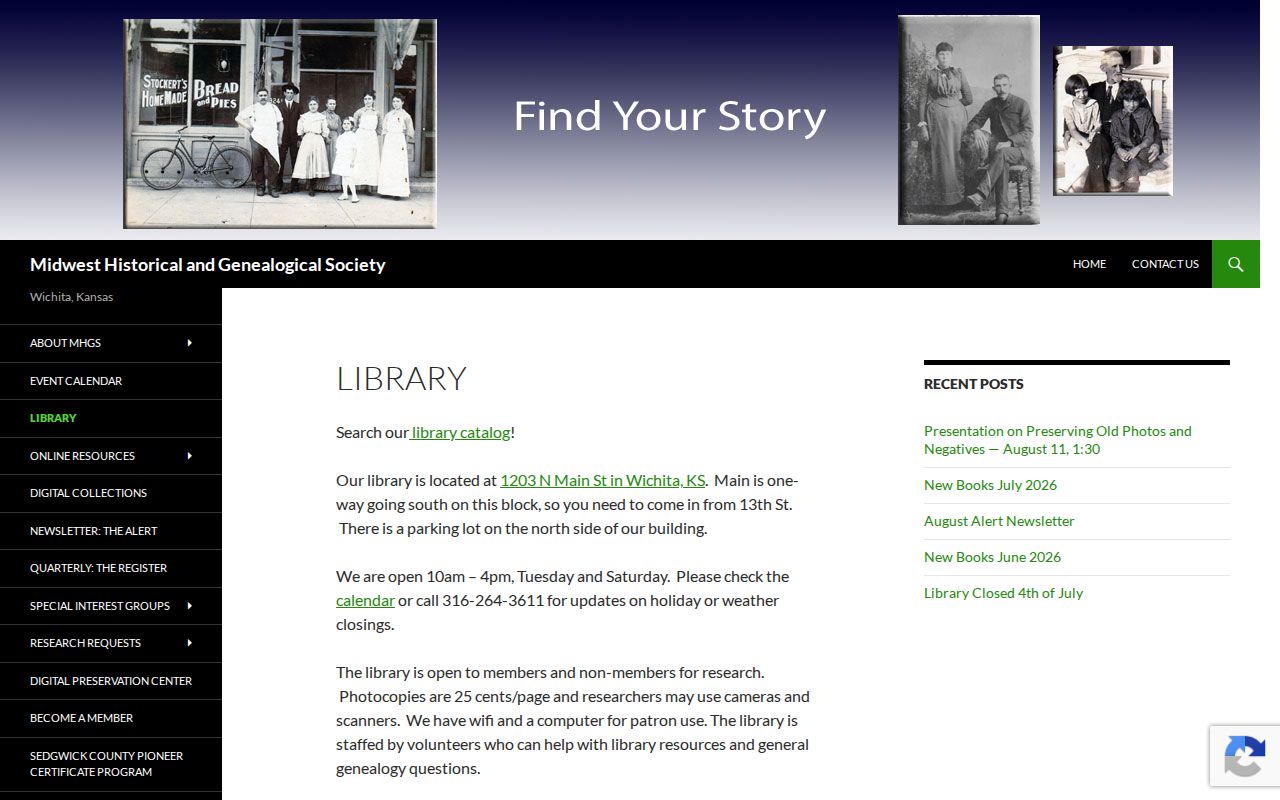
The Midwest Historical and Genealogical Society library, 1203 N Main, is open Tuesday and Saturday from 10 a.m. to 4 p.m. It welcomes members and nonmembers and supplies computers, Wi-Fi, cameras, scanners, and 25-cent copies. This captured library page points to the Wichita and Sedgwick County collections used alongside city directories.
Call 316-264-3611 before a special trip. Ask whether the target year is a full directory, a names-only extraction, a business volume, or a scan that must be viewed in person.
Extend Wichita Directory Findings
A directory hit gains strength when another local source supports it. MHGS indexes include naturalizations from 1870 through September 26, 1906, early census material, probate, land owners, the Wichita Death Index for 1887-1910, yearbooks, cemeteries, and the Wichita Eagle and Beacon obituary index from 1955 forward.
The library's Negro Star run from 1920-1953, local newspaper microfilm, maps, cultural histories, church records, and family histories can recover names that a mainstream directory omitted or spelled differently. Kansas Historical Society county microfilm can travel through Kansas libraries, while its research room holds government records and older offline finding aids.
For a former classmate, combine a yearbook name with a newspaper item or obituary index, then use a later public affiliation only as a lead. Do not turn an old school listing into a claim about a current address.
Note: An index points toward a source; it does not replace the original directory page, obituary, deed, or archive file.
Explain Wichita Directory Gaps
An absent name has several possible causes. The person may have moved, died, used initials, lived outside a publisher's coverage, boarded under another householder, or simply been missed. A stale scan link can also mimic a missing edition. Wichita's old street labels, abbreviated types, honorary overlays, and annexations can separate a correct name from its modern address.
Other local records bridge the gap. Sedgwick County preserves assessment rolls from 1876-1898, though some years and townships are missing or damaged. Wichita death certificates cover 1887-1910 in the historical trail. County coroner books contain gaps, but a WPA project made alphabetized cards from journal entries in 1936. Newspapers, cemetery files, deeds, probate, and those cards may carry a household across a blank directory year.
Trace Family Through Wichita Directories
Family research works best as a year-by-year log. Keep the printed entry in one column and the modern interpretation in another. That protects the source text while allowing street changes and name variants to be tested.
- Choose a known Wichita address and the nearest available directory year. Search the street section and record its page.
- Find the occupant in the alphabetical section. Preserve initials, spouse or widow wording, occupation, and tenure marks.
- Repeat in the next available edition. Test spelling changes and address abbreviations rather than forcing an exact match.
- Pair directory years with released federal census schedules, which become public after 72 years. Compare household and location details.
- Use a deed, assessment roll, obituary, cemetery record, probate index, or newspaper to explain a move or disappearance.
Current property ownership should not be projected backward. A directory occupant and a deed owner may be different people. For the modern parcel chain, shift to the Wichita street records method, which keeps current appraisal and GIS evidence separate from the historical shelf.
A clean research note cites the directory title, publisher when known, year, section, page, repository, and image-access date. It also states whether the name came from OCR or direct image inspection.